
SAF-to-KLOE Bridging Tool
Prepare once. Cover both frameworks.
CQC is moving from the Single Assessment Framework to a new sector-specific model. The consultation has closed, piloting is underway, and implementation is expected before the end of 2026. Until then, the SAF remains the framework your service is inspected against.
This puts every provider in the same position: building evidence for a framework that is already being replaced, without knowing exactly when the switch happens.
The Bridging Tool maps your current SAF evidence directly onto the incoming Key Lines of Enquiry, so the work you do now still counts when the new framework lands.
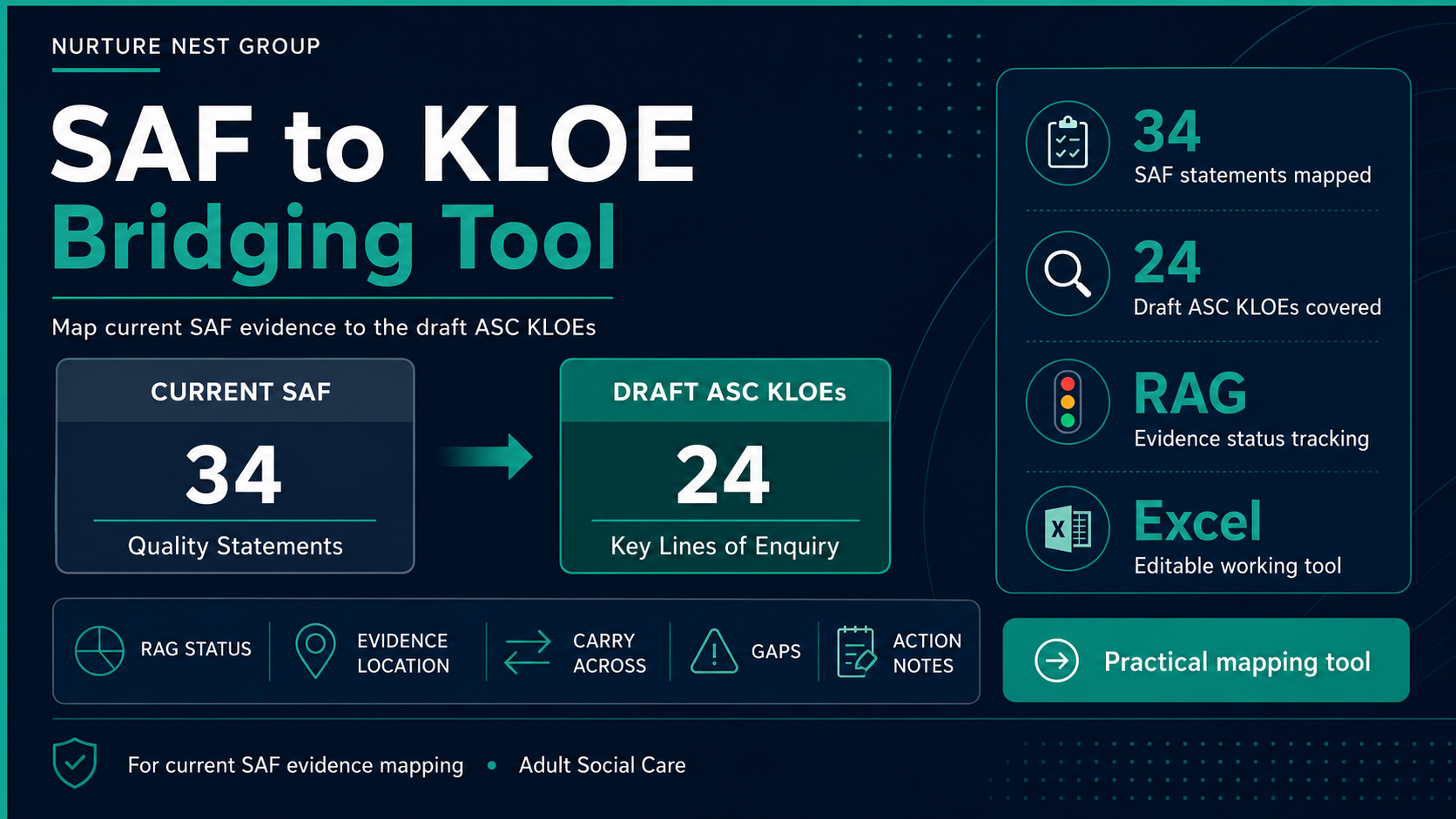
The SAF-to-KLOE Bridging Tool is a structured mapping document that translates your current evidence position under the Single Assessment Framework's 34 Quality Statements onto the incoming Key Lines of Enquiry framework — so that the evidence you've built, or are building, works for both what's being assessed right now and what will be assessed from late 2026.
What It Covers
The Bridging Tool takes all 34 current SAF Quality Statements and maps each one to its likely successor under the draft Key Lines of Enquiry, statement by statement, across all five Key Questions: Safe, Effective, Caring, Responsive and Well-led.
For every statement, you get:
The verdict. Whether your evidence carries forward directly, needs re-scoping, needs merging into a combined line of enquiry, gets dispersed across several new areas, moves to a different Key Question entirely, or has been removed altogether.
A confidence rating. CQC has not published an official mapping between the old and new frameworks. Where a mapping is close to certain, the tool says so. Where it is our informed reading of the draft rather than a confirmed fact, it says that too.
What to verify. A plain-English note on what to check in your own evidence before you rely on the mapping.
Level risk. Whether your existing evidence proves the right topic, or whether it needs to go further and demonstrate outcomes, since the new framework judges services against detailed rating characteristics, not just subject coverage.
Effort required. A quick read on whether a given change is a light re-label, a moderate re-file, or a substantial piece of work.
A sequenced action plan. Every one of the 34 statements sorted into three phases: the changes that carry real inspection risk if missed, the changes that need re-filing, and the changes that only need a name update. You do not have to work out where to start. The tool tells you.
A live progress tracker. As you work through the plan and mark evidence as reviewed, the tool counts your progress automatically.
What changes once you have used it
Before the Bridging Tool, most services are treating framework transition as background noise, something to worry about once CQC confirms the final version. That leaves preparation until the last minute, under time pressure, with no clear order of priority.
After using the Bridging Tool, you know exactly which parts of your evidence base are safe as they are, which need attention now, and which can wait. You are not guessing which folder to open first. You are working through a plan that has already done the hardest part: reading the draft framework in detail and translating it into a set of concrete actions for your service.
Services that are new, or starting largely from scratch, use the tool differently. Rather than migrating old evidence, they build their evidence structure directly against the new Key Lines of Enquiry from day one, using the same tool as a blueprint. No wasted effort moving through a framework that is already on its way out.
Either way, the outcome is the same: your evidence is ready for whichever framework is in place when your inspection happens, not just the one that happens to be operative today.
Who this is for
Registered managers and quality leads who want a clear, sequenced plan rather than a vague sense that "things are changing"
Providers with an inspection due in the next six to eighteen months who want their preparation to hold up regardless of which framework is live on the day
New services building an evidence structure from the ground up, who want to build it right the first time
Multi-site or multi-service providers who need one consistent tool their whole team can work from
Anyone who has read about the framework changes and still is not sure what it actually means for their own service on Monday morning
The problem this solves
Right now, providers are stuck preparing for a moving target.
Build evidence purely around the current 34 Quality Statements, and some of that structure will not transfer cleanly once the new Key Lines of Enquiry arrive. Wait for the final framework before doing anything, and you risk being under-prepared if inspection comes first.
Most services do not have the time to track CQC's consultation process, read the draft framework line by line, and work out which of their existing folders, policies and evidence will survive the transition and which will not.
The Bridging Tool does that work for you.
What it covers:
What the tool actually does
The Bridging Tool takes all 34 current SAF Quality Statements and maps each one to its likely successor under the draft Key Lines of Enquiry, statement by statement, across all five Key Questions: Safe, Effective, Caring, Responsive and Well-led.
For every statement, you get:
The verdict. Whether your evidence carries forward directly, needs re-scoping, needs merging into a combined line of enquiry, gets dispersed across several new areas, moves to a different Key Question entirely, or has been removed altogether.
A confidence rating. CQC has not published an official mapping between the old and new frameworks. Where a mapping is close to certain, the tool says so. Where it is our informed reading of the draft rather than a confirmed fact, it says that too.
What to verify. A plain-English note on what to check in your own evidence before you rely on the mapping.
Level risk. Whether your existing evidence proves the right topic, or whether it needs to go further and demonstrate outcomes, since the new framework judges services against detailed rating characteristics, not just subject coverage.
Effort required. A quick read on whether a given change is a light re-label, a moderate re-file, or a substantial piece of work.
A sequenced action plan. Every one of the 34 statements sorted into three phases: the changes that carry real inspection risk if missed, the changes that need re-filing, and the changes that only need a name update. You do not have to work out where to start. The tool tells you.
A live progress tracker. As you work through the plan and mark evidence as reviewed, the tool counts your progress automatically.
This is not a CQC-endorsed document, and it does not replace the source material. CQC's draft framework remains subject to change following consultation and piloting, and this tool is built on the most recent published draft available at the time of writing. Every mapping carries a confidence rating so you always know whether you are looking at a near-certain read or an informed judgement.
This also is not a substitute for a full inspection readiness review. It is a self-directed mapping and planning tool.
Questions? anthony@nurturenestgroup.com | www.linkedin.com/in/anthony-matthias-64508239a
Frequently Asked Questions
-
No. The SAF remains the framework CQC currently inspects against. The draft sector-specific frameworks are in consultation and piloting, with implementation expected later in 2026. This tool helps you prepare in the meantime so you are ready for either.
-
Yes. Once the final adult social care framework is confirmed, an updated edition of the tool will reflect any changes from the current draft.
-
Yes, arguably more so. The tool includes a dedicated section for services starting fresh, showing you how to build your evidence structure directly against the new framework rather than the one being phased out.
-
You can reach us anytime via our contact page, email or LinkedIn messenger above. We aim to respond quickly, usually within one business day.
-
Most services spend two to four hours on the initial review, then work through the Priority Action Plan over several weeks alongside normal operations. The tool is designed to fit around day-to-day work, not replace it.
-
Book a free 20-minute conversation with Anthony, or consider our Inspection Readiness Review for an independent, evidence-tested assessment of your position.